What Is Dividend Yield?
Dividend yield is annual dividends divided by share price. What counts as a good yield, and why a very high one is usually a warning.
Dividend yield is a company's annual dividend per share divided by its share price, expressed as a percentage. A stock paying $3 a year while trading at $100 yields 3%. It tells you the cash income you receive for each dollar invested, before any change in the share price.
It is the standard way to compare income across stocks of very different prices — and, crucially, a very high yield is more often a warning than a bargain.
How dividend yield is calculated
Dividend yield = (Annual dividend per share ÷ Share price) × 100
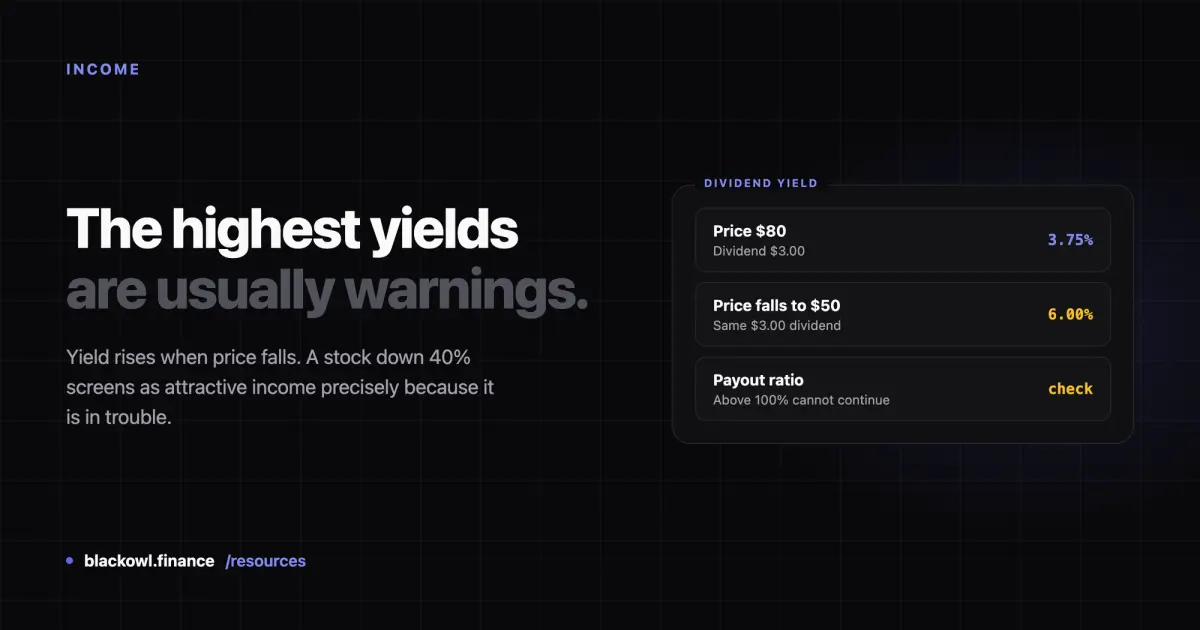
A worked example. A company pays $0.75 per quarter, so $3.00 a year, and trades at $80:
($3.00 ÷ $80) × 100 = 3.75% yield
Note what happens if the share price falls to $50 while the dividend holds:
($3.00 ÷ $50) × 100 = 6.0% yield
The yield rose 60% because the stock dropped. Nothing improved. This inverse relationship is the single most important thing to understand about the metric.
Trailing vs forward yield
Trailing yield uses dividends actually paid over the last twelve months. Factual.
Forward yield annualises the most recent dividend, or uses the declared next-year figure. More current, but it assumes the payout continues — which is exactly the assumption that breaks when a company is in trouble.
What is a good dividend yield?
For US large-caps, roughly:
| Yield | Typical reading |
|---|---|
| 0% | Reinvesting everything — common in growth and tech |
| 1–2% | Modest income, usually alongside growth |
| 2–4% | The mainstream range for established payers |
| 4–6% | High — normal in utilities, REITs, energy |
| Above 6–8% | Investigate before buying |
The S&P 500 as a whole has typically yielded somewhere around 1.5–2% in recent years.
Sector matters more than the market average. Utilities, REITs and telecoms structurally yield more because they distribute most of their earnings rather than reinvesting. Technology companies often pay nothing at all — that is a capital allocation choice, not a defect. Comparing a software company's yield to a utility's tells you nothing useful.
Why a very high yield is usually a warning
This is the trap, and it follows directly from the formula. Yield rises when price falls, so the highest-yielding stocks on any screen are frequently the ones the market has marked down hardest.
The yield trap. A stock drops 40% on deteriorating fundamentals. Its yield mechanically jumps from 4% to nearly 7%. It screens as attractive income precisely because the business is in trouble.
Dividend cuts follow. A payout the company cannot afford does not survive. When it is cut, income investors lose both the dividend and more of the share price — the cut itself usually triggers further selling.
Check the payout ratio. Dividends ÷ earnings, or better, dividends ÷ free cash flow. Below 60% is generally comfortable; above 80% leaves little room for a bad year; above 100% means the company is paying out more than it earns, which is funded by debt or asset sales and cannot continue indefinitely.
Confirm the cash is there. Earnings can be shaped by accounting; the cash flow statement is harder to dress up. A dividend covered by reported EPS but not by cash is a dividend at risk.
What yield does not tell you
It ignores growth. A 2% yield growing 10% a year overtakes a static 5% yield within about a decade, and pays more thereafter. Dividend growth history is frequently more informative than current yield.
It ignores total return. Yield is only the income component. A stock yielding 5% that falls 15% delivered a negative year.
It ignores buybacks. Many companies return cash by repurchasing shares instead of paying dividends. That is a real return to shareholders that yield does not capture at all.
It says nothing about safety. Yield measures what is being paid now, not whether it will still be paid next year.
See dividend yield on real companies
Key Statistics on each stock page shows Div. Yield alongside the valuation figures:
Several of these pay little or nothing — that is the point. Large, highly profitable companies can rationally choose reinvestment and buybacks over dividends.
Sources
- U.S. SEC (investor.gov) — Stocks: how investors earn returns
- FINRA — Stocks
Frequently asked questions
What is a good dividend yield?
For US large-caps, 2–4% is the mainstream range for established dividend payers, while utilities and REITs commonly run 4–6%. There is no universal target — what matters is whether the payout is sustainable and how it compares to the company's own sector and history. A 0% yield is not a flaw; many profitable companies reinvest instead of paying dividends.
Is a high dividend yield good?
Not necessarily, and often the reverse. Because yield is the dividend divided by the share price, it rises automatically when the price falls. A yield above roughly 6–8% frequently reflects a stock the market has marked down on deteriorating fundamentals, and it is often followed by a dividend cut. Check the payout ratio and whether cash flow covers the dividend before treating a high yield as attractive.
What is a payout ratio?
The payout ratio is dividends divided by earnings, showing what share of profit is being distributed. Below 60% is generally comfortable, and above 100% means the company is paying out more than it earns — funded by debt or asset sales, which cannot continue indefinitely. Measuring the payout against free cash flow rather than earnings is a stricter and usually more reliable test.
Related Articles
What Is EPS? Earnings Per Share Explained
EPS is a company's profit divided by its shares outstanding. What it measures, how to read it, and where it misleads.
What Is Free Cash Flow?
Free cash flow is the cash a business generates after paying to maintain and grow its asset base. Why it is harder to fake than earnings.

How to Research Stocks
A practical order for researching a stock: what the business does, whether it makes money, whether the profit is real, and what you are paying for it.
Invest Smarter with Blackowl
Blackowl is your AI-powered financial copilot, helping you track, analyze, and optimize your investments with ease.
- AI-powered insights
- Portfolio tracking
- Dividend management
- Performance analytics