What Is a Good Profit Margin?
A good profit margin depends almost entirely on the industry. The three margins that matter, typical ranges, and what they reveal.
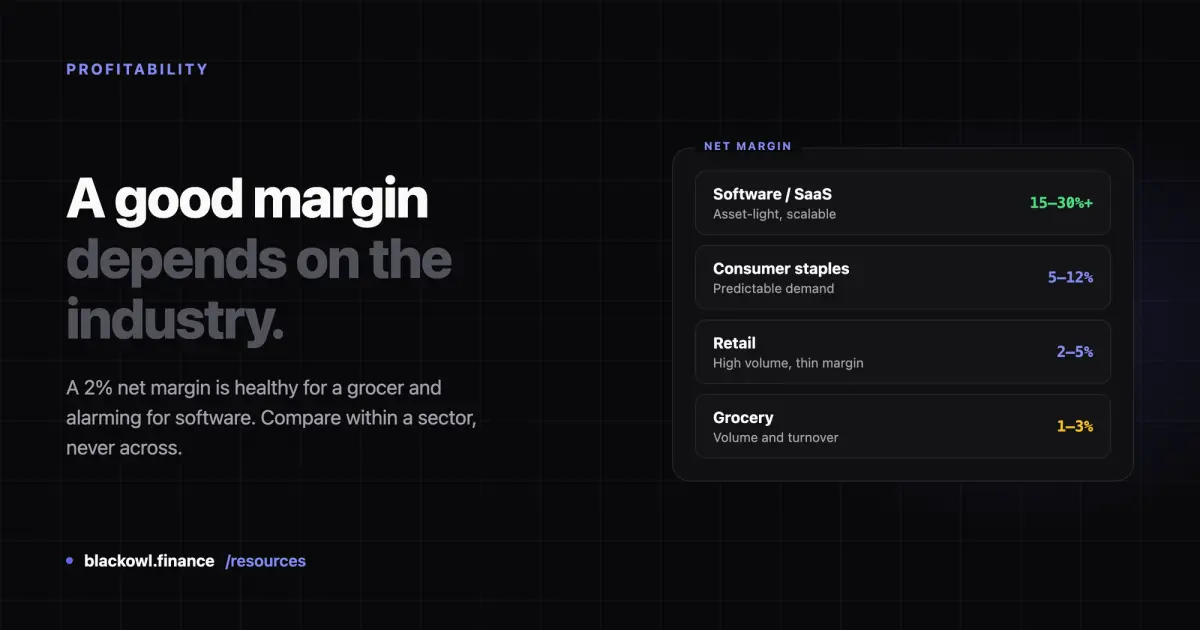
A good profit margin depends almost entirely on the industry. A 5% net margin is healthy for a grocery chain and alarming for a software company. As a rough general anchor, a 10% net margin is considered solid and 20% strong — but the sector comparison matters far more than any universal number.
Profit margin is profit divided by revenue, expressed as a percentage. It answers a simple question: of every dollar of sales, how much does the company keep?
The three margins worth knowing
They sit at different points on the income statement, and each answers something different.
Gross margin = (Revenue − Cost of goods sold) ÷ Revenue
What is left after the direct cost of making the product, before overheads. This one mostly reveals pricing power and the fundamental economics of the business. Software has very high gross margins because copying software costs almost nothing; a grocer's is thin because it buys goods and resells them at a small markup.
Operating margin = Operating income ÷ Revenue
After overheads — salaries, R&D, marketing, rent — but before interest and tax. Usually the best single measure of operational efficiency, because it strips out financing structure and tax rates.
Net margin = Net income ÷ Revenue
What remains after everything, including interest and tax. This is the figure people usually mean by "profit margin", and the one that feeds EPS.
A worked example. A company with $500 million revenue, $300 million cost of goods, $120 million operating expenses, and $40 million of interest and tax:
- Gross margin: ($500m − $300m) ÷ $500m = 40%
- Operating margin: ($200m − $120m) ÷ $500m = 16%
- Net margin: ($80m − $40m) ÷ $500m = 8%
Typical ranges by industry
Orientation, not thresholds:
| Industry | Typical net margin |
|---|---|
| Software / SaaS | 15–30%+ |
| Pharmaceuticals | 15–25% |
| Banks | 20–30% |
| Semiconductors | 15–30% (highly cyclical) |
| Consumer staples | 5–12% |
| Industrials | 5–12% |
| Retail | 2–5% |
| Grocery | 1–3% |
| Airlines | 1–8% (deeply cyclical) |
The spread here is the point. Comparing margins across industries is close to meaningless. Compare a company to its direct competitors and to its own history.
Low margins are not automatically bad. A grocer running 2% net margin on enormous volume with fast inventory turnover can generate excellent returns on capital. Margin is one input; how much capital the business needs is another.
What margins reveal
Trend over time is the most useful signal. Expanding margins usually mean pricing power, scale, or cost discipline. Contracting margins point at competition, input cost inflation, or a weakening position. Several years of direction tells you more than one year's level.
The gap between gross and net shows where money goes. A company with 70% gross margin and 5% net margin is spending heavily somewhere between — possibly on R&D and sales while growing, possibly on bloat.
High margins attract competition. Unusually high margins are a signal to competitors. The question is whether something protects them: a brand, a patent, network effects, switching costs. Margins with no defence tend to erode.
Where margins mislead
One-off items distort them. An asset sale, legal settlement or writedown lands in net income and can make a single year look excellent or terrible for reasons that will not repeat.
Accounting profit is not cash. A company can report healthy margins while free cash flow is negative. Check that margins convert into cash.
Margin says nothing about capital intensity. Two companies with identical 10% net margins are not equivalent if one needs three times the assets to produce the same revenue. Return on equity and return on invested capital cover what margin misses — see what is a good ROE, and why debt can fake one.
Deliberately suppressed margins. A company investing heavily in growth may run thin margins by choice. That is a strategy, not weakness — provided the investment is producing growth.
See margins and returns on real companies
Key Statistics on each stock page shows profitability measures including ROE, ROA and ROI:
Compare these within their sectors. The gap between a semiconductor company and an e-commerce business is structural, not a judgement about quality.
Sources
- U.S. SEC (investor.gov) — Stocks: how investors earn returns
- FINRA — Stocks
Frequently asked questions
What is a good net profit margin?
As a general anchor, a 10% net margin is considered solid and 20% strong, but the industry matters far more than any universal figure. Software companies routinely exceed 20%, while grocery chains operate on 1–3% and are perfectly healthy doing so. Compare a company to its direct competitors and to its own margin history rather than to a market-wide benchmark.
What is the difference between gross, operating and net margin?
Gross margin is what remains after the direct cost of producing the goods, and reveals pricing power. Operating margin subtracts overheads like salaries, R&D and marketing, and is usually the best measure of operational efficiency. Net margin is what is left after everything including interest and tax. Each sits at a different point on the income statement and answers a different question.
Can a company with low margins be a good investment?
Yes. Margin is only one part of the picture. A retailer running 2% net margin on very high volume with rapid inventory turnover can produce strong returns on the capital invested. What matters is the combination of margin, how fast the business turns over its assets, and how much capital it needs — not margin in isolation.
Related Articles
What Is a Good ROE?
Return on equity measures profit against shareholder capital. Why 15–20% is the usual benchmark, and why debt can fake it.

What Is Free Cash Flow?
Free cash flow is the cash a business generates after paying to maintain and grow its asset base. Why it is harder to fake than earnings.

How to Research Stocks
A practical order for researching a stock: what the business does, whether it makes money, whether the profit is real, and what you are paying for it.
Invest Smarter with Blackowl
Blackowl is your AI-powered financial copilot, helping you track, analyze, and optimize your investments with ease.
- AI-powered insights
- Portfolio tracking
- Dividend management
- Performance analytics